| Manufacturer: | Holland's Shooter Supply |
| Model Number: | Tactical 2.5-10x42mm |
| Finish: | Matte |
| Magnification: | 2.5-10.0 |
| Objective: | 42mm |
| Tube Diameter: | 30mm |
| Weight: | 20.0oz/567g |
| Eye Relief: | 3.0-3.5"/79-97mm |
| Click Value: | .25 MOA Wind .5 MOA Elev |
| Adjustment Range: | e. 28 MOA with stops w. 14 MOA with stops |
| Reticule: | Custom Tactical |
| List Price: | $1295 |
| Street Price: | ??? |

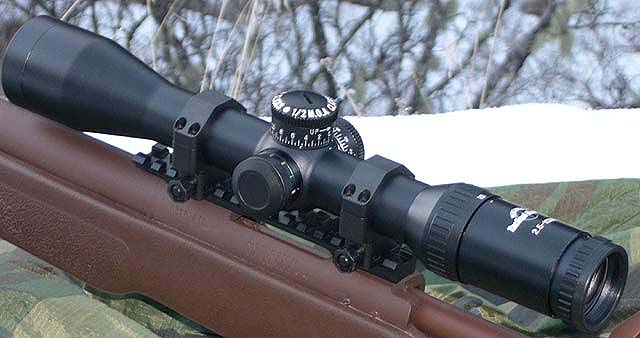
The knobs are of a very nice shape. They are large in diameter with a good gripping surface, but they are not too tall. They have a very good feel to them and have good tactile clicks, but not audible, the way I like them. The windage is 1/4 MOA clicks while elevation is 1/2 MOA. Both the windage and elevation knobs have "lockouts" while the scope itself has a much larger adjustment range, the elevation knob only rotates in the positive direction from zero and only rotates 28 MOA. Now, this is done on purpose as the scope is designed to be used with the reticule for long range shooting. I'll explain more below. Likewise, the windage knob only rotates 7 MOA each direction, for a total of 14 MOA. Now, both the elevation knob and the windage knob can be slipped to zero after you zero your rifle. One thing I do really like on the windage knobs is that the numbers count up in both directions. This makes it nice and easy to instantly see how many MOA you are corrected in either direction. The down side is that the knobs only go to 7 MOA in each direction, which will get you out to 800 yards with a .308 175gr at 2600fps in a 10mph direct crosswind, but not further (or in higher winds) without holding. Its the same for the elevation, if zeroed at 100, the 28 MOA would get you to 800 yards with the same load (remember, the 28 MOA is all positive, so its able to get you to 800). But, it is the MOA dialed in on your knob used in conjunction with the reticule that will allow you to go further, or the same distances without as much dial adjustments. The lack of the ability to go below zero can be a problem in slope dope (slanted angle) shooting at close ranges (same as or less than your zero) when you need to compensate by aiming low. Even if it was just 2 MOA below it would cover most situations. Granted, because the design of the scope is setup to use the reticule for longer ranges, you would only run into this situation when shooting at your zero distance or less (more common with LE tactical shooting).
The other knob to take note of is the one on the left (opposite the windage) which is not a parallax adjust, but a lighted reticule control. This is a very convenient location for it. It rotates both directions, one direction has 5 brightness settings for the reticule in green and the other direction has 5 brightness settings for the reticule in red. There is an off location in the middle of the dial on both sides (it rotates all the way around). I'd like to see a little dimmer setting on the bottom, but on the whole, the lighted reticule works very well, and the option of two colors is unique, though perhaps not a huge benefit.
The magnification dial has a positive grip and is firm, but easily used. The overall finish on the scope is excellent, with a good even matte black. There might be a bit too much white lettering for a tactical scope, but a sharpie can help make things a bit more tactical. Taken on the whole, this is a very nice well made tactical scope of 2.5-10x42mm. The optics are clear, the dials are nice with some nice features. But there is still one major piece, perhaps the single biggest, that needs to be talked about, and that is the reticule and how the elevation dial has been designed to work in conjunction with the reticule.
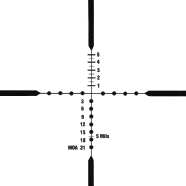
The reticule is the one very significant unique feature of this scope. Across the horizontal stadia there is the traditional football shaped mil-dots, just as they would appear in a Leupold or other scope. But it is the vertical markings that set the scope apart. Above the horizontal stadia and going up, there are larger horizontal lines that indicate full mils, and then small lines that indicate half mils allowing for accurate mil readings. Below the horizontal stadia there are 7 dots on 3 MOA intervals, going up to 21 MOA. The space between the 7th dot and the start of the thicker stadia is also 3 MOA, giving aiming points up to 24 MOA. Each dot has a small text label next to it indicating the MOA. (i.e. the 7th dot has a 21 next to it indicating 21 MOA) There is also a line indicating 5 mils from the horizontal stadia. This is used to mil targets that are over 5 mils in height. There is a lot going on in the reticule, making it a bit "busy". The reticule is on the 2nd Focal Plane, so it stays the same size, and the measurements (mils and MOA) are accurate only at 10x.
So how do you use all these dots? Well, its rather simple, but you MUST know your ballistics. To help out with determining your ballistics, each Tactical Hunter scope ships with a copy of Sierra's excellent Infinity V software. Once you learn your ballistics and have it written out in MOA, its rather easy to compensate for long range shooting. The idea goes like this: You zero your rifle and scope at 100 yards, and then slip the rings (knobs) to indicate zero elevation and zero windage. Now, let us say you are shooting at a target at 400 yards. You would then look at your ballistics chart (or memorize it for those of us in the tactical world) and see that you need to go UP 8.6 MOA (308 Federal 175gr GMM in standard conditions). Well, since there is a 9 MOA dot in the reticule, simple hold on the 3rd dot down, and fire. Technically you'll be off .4 MOA, but for long range tactical shooting, you are good to go. At 600, you need 16.75 MOA of up, so in this case, you would hold on the 15 MOA dot, and dial in 1.5 MOA of up. This is why the elevation dials only rotate up and stop at zero. You should, in theory, never have to dial in more than a few MOA. At least until you run out of MOA dots. This happens at about 800 yards with the 175 gr 308 match load. Then you would be dialing in more MOA to get you to 1000 and beyond (if desired).
The system works well, though you may find yourself estimating the MOA's using the dots rather than aiming with a dot and dialing in the remaining adjustments on the dials. This is a faster way of doing it and one that many shooters would more than like practice but most shooters are more accurate if they have a specific aiming point rather than holding off. Because of this I personal would like to see horizontal lines for the MOA marks instead of dots which cover a good portion of the target at longer rangers. But Darrell Holland brought up a good point that circular dots have been found to more easily be centered by the human brain while aiming. All this being said, I would probably prefer a BDC, but the problem with BDC's is that they are good for only one specific loading, where as the Holland System is good for any load, you just have to compute the ballistics. The BDC's also require that you dial everything in, which can amount to a large amount of adjustments, where the Holland system required very little manipulation of the dials. The system did work fairly well and is easy to understand once you have everything computed.
In summary, the scope is well made and has nice optics and features. The concept is different, but does work and the entire scope is worth looking into for long range tactical shooting, especially with handloads or other odd loads that would not have a BDC available. It is nice to see some new things happening in the field of optics. An adjustable AO would be nice since the magnification covers a wide spectrum, but the scope is designed around mid/long range shooting, which means the set distance for parallax will cover most of its designed ranges. I do think having the option of using the lock outs on the knobs or not, would be a nice feature, as many shooters may prefer to dial in exact adjustments and aim with the center crosshair. But even with the lock outs, there is enough MOA to take the 175gr match to 800 yards by directly dialing in the adjustments. Using a canted base would not help also because of the lockouts... you will always only have the 28 MOA. But if you use the reticule system as the scope was designed, it works well... Holland has a nice scope here.