|
.308 Match Ammo Comparison
Table of Contents
Introduction and Test Procedures A while back I wrote about various match grade factory ammunition loads that were available and described my feelings about each of them. But, that article was not very complete and it did not provide much testing data to go off of. For a while now I have been wanting to revisit the subject and try to provide some empirical data as well as try out several other manufacturers 308 match ammo. I also wanted to establish a set of test procedures that were standardized as well as a format to the article that was expandable so that I could review and add other manufacturers ammunition to the test later without having to redo the entire review article. Once I had set it in my mind what I wanted to do, I set out to gather all of the ammo I wanted to test for the first go around. I wanted to stick to the 168gr class of ammo for this initial test and figured I would open it up to other match loadings (175gr & 155gr) down the road and possibly even other cartridges beyond the 308. I then needed to set a standard for the tests. I wanted to take out as many of the variables as I could, but I needed to keep it simple (not a ton of rounds or complex mechanisms like a rifle vise). Without a serious vise I know that shooter error will come into play and I wanted to incorporate multiple shooters but ruled it out due to the constraint it would place when we went to add new loads down the road as the chances of getting the same shooter may be difficult. But I did settle on the fact that two rifles will be used for the test. Both rifles are permanent fixtures with Sniper Central and the same two rifles will always be used for future tests. More info on the rifles is provided later in this article. So, after a lot of thought, here is the accepted test procedure for each make of ammunition.
There is no doubt that the test has flaws, but I have done my best to limit them as best as I could and still provide some useful data. This is why I included the chronograph results as this provides some true empirical data to examine, and not just some accuracy comparisons shot by a single shooter. I have provided all the procedrues so you can take the test results for what they are worth! 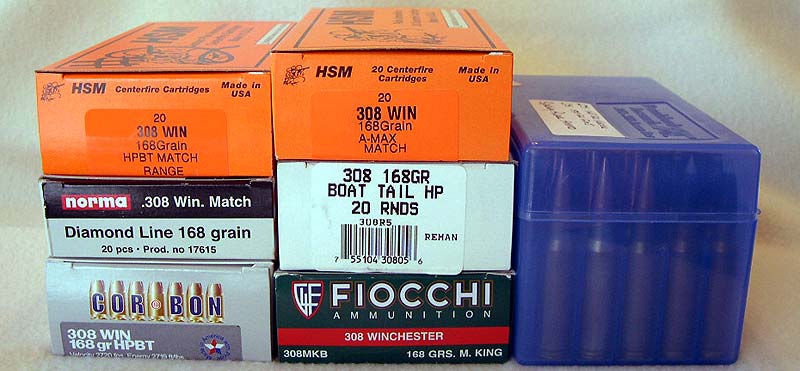 Round 2 Group of Ammo The Test Rifles For the tests, I wanted to have two rifles represented, a standard factory produced tactical rifle and a high end custom tactical rifle. I also needed to know that I would have these rifles for a long time to come so I could add more ammo as time goes by and still be able to do the same tests with the same rifles. The two rifles I settled on was our Remington 700 mule rifle which is a 700 SPS-V in 308 with a 26" barrel set into a remington 700P HS Precision stock. The SPS-V barreled action is the same as the 700P, 700 VS, and other remington heavy barrel rifles. It still does retain the X-Mark pro trigger which is set to 3 lbs. This rifle is essentially a 700P and represents a very popular and common tactical rifle in use by many agencies and has typically fired about .75 MOA with Federal GMM. The scope used currently is a Mueller 4-16x50mm Tac I. All groups were fired with the scope set on 16x. 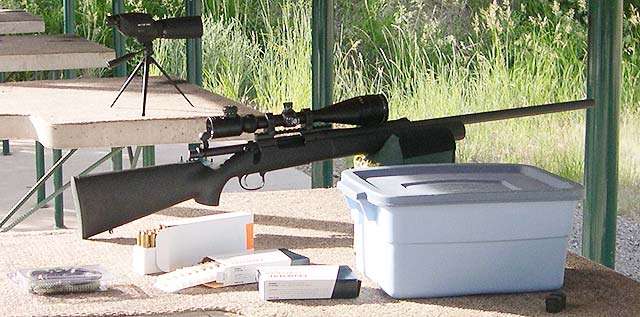
Remington 700 Test rifle at the cleaning/fouler station The second rifle used for the high end tests is a Tactical Operations Bravo-51 with a 22" barrel. This rifle will shoot sub .25 MOA with federal gold medal match ammo if the shooter does his part. It is a very high end rifle with very high accuracy requirements before leaving the factory. The rifle is also threaded for a suppressor and all groups were indeed fired with a Tactical Operations suppressor attached to the rifle. The rifle is pretty much setup as it came from the factory except for the tests I have replaced my normal scope (Leupold Mark 4 10x M3) with a Leupold Mark 4 16x M1 in order to meet the criteria of 16x for group firing. 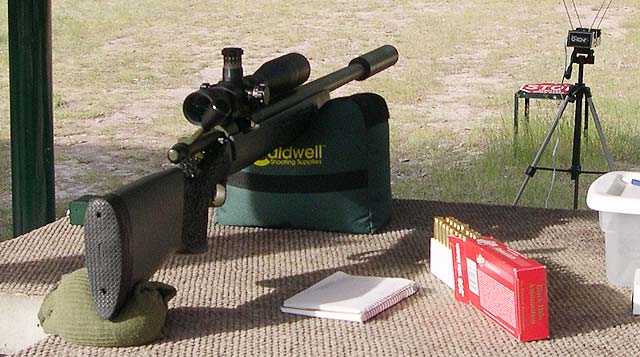
Bravo-51 at the group firing station These rifles should serve as a good sample of what might be expected with this ammo performing in various rifles. Tac-Ops guarantees their rifles using the Federal GMM ammo, but I am not aware of anything special they do specifically for that ammo. Beyond that, these rifles will be in our inventory for a long time to come and we might as well get going with the test results! Test Results 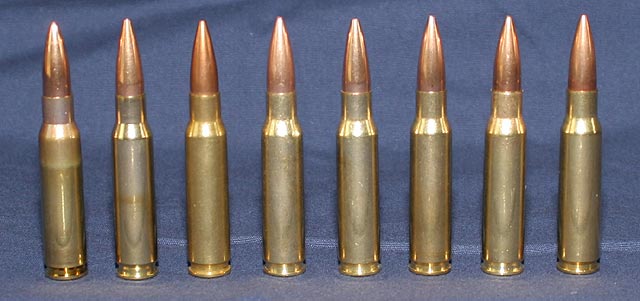
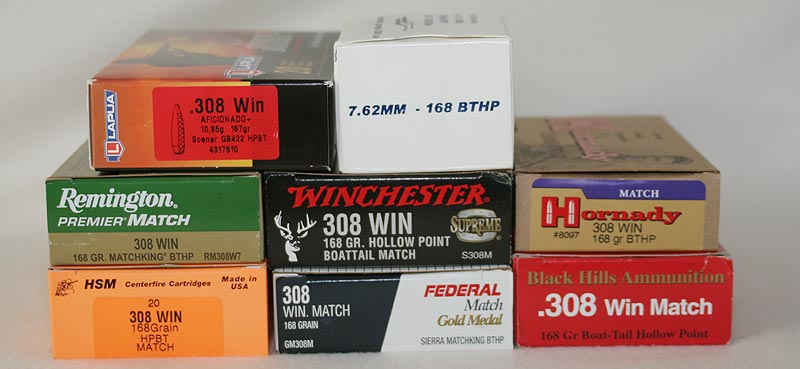
l-r: Lapua, Hornady, ABT, HSM, Blackhills, Winchester, Remington, Federal The initial test included 8 manufacturers of match grade ammunition including Lapua, Hornady, American Ballistics Technology (ABT), Hunting Shack Munitions (HSM), Blackhills, Winchester, Remington and Federal. There will be more added over time as we continue to test more match grade ammunition. The summary of the results is included in the table below, but be sure to visit each manufacturers result page to find out more specific details on how the ammo performed as well as photos of the ammo, best groups fired, price, etc. The 2nd round of tests conducted about 10 months after the initial test, included two loads from HSM, the lower price Match Range ammo as well as their AMAX match ammo we have heard so much good things about, as well as the highly regarded Norma Diamond Line ammo, Fiocchi, Ultramax (Remanufactured ammo), Cor-Bon which we had such good luck with their .260 Match ammo, and a new boutique custom ammo loader called Spring River. Check out the detailed pages below for more information on these loads.
Conclusion and Thoughts So, after all of this shooting and note taking, what conclusions can be drawn? As most all shooters know, rifles will favor a particular load for what ever reason, and I do not think I have proven otherwise with these tests. I would also venture to say that the single biggest limiting factor of modern factory match ammunition is the person behind the rifle. While I tried to take out as much human factor as I could, the rifle was still not in a clamped down vise with a mechanical device pulling the trigger, and therefore the groups were subject to the shooter and his errors. Which as we well know can be effected by many many things. I do plan to re-fire some of the above manufacturers to see if better results can be achieved, and we'll see how those go. There are a few things of note that I would like to mention. It does appear that a nice tight chamber and a high quality barrel on a custom built rifle does effect things, as you will notice that the standard deviation and extreme spreads were reduced with the Bravo-51 on all but two of the loads and on the average of all the loads together. On some of them, it was very significant. The 700P actually has fewer rounds through it than the Bravo-51, so we cannot put blame on throat wear or anything like that. Though this discovery really isn't that surprising, BUT, perhaps the average velocities are. The 700P has a 26" barrel and the Bravo has a 22" barrel (23" if you measure it the same as Remington does) but the velocities were HIGHER in the Bravo-51 with the shorter barrel, which is contrary to accepted theories. I believe there are a few reasons as to why this is the case. The Bravo-51 has a custom barrel made for me with only three lands and grooves which puts a bit less drag on the bullet as it travels down the barrel vs. a five or six land and groove barrel. I have no real empirical evidence that I can offer to support a claim that this will actually increase velocities, but, in theory it should. The second potential reason why we have extra velocity is because of the tighter match grade type chamber which should seal tighter with less energy being used to expand the brass vs. sending the bullet down the barrel. And my final idea as to why the velocities may be higher with the shorter barrel is because these .308 match loadings are fairly low power and we may actually be getting close to the maximum barrel length at which the .308 reaches it max velocity. I have read that this usually happens around 30" for the .308, but I think that is for higher velocity full power loads like the 155gr palma loads (palma rifles have long barrels). If you look at the results of the Lapua loading, it is a very hot load, the fastest of this group by far, and you will notice that in the longer 26" barrel it outpaced the shorter Bravo-51 barrel by 30 fps. The hotter loads utilize the longer barrels to generate the higher velocities, but the lower power loads seem to possibly be reaching their max velocity around the 24" barrel length. Of course, all of the above are non scientific theories of my own as to why the average velocities in the shorter barreled Bravo-51 were higher than the longer barreled 700P. So which ammo is the best? Well, that will have to be left up to you to decide. I think they are all acceptable to use and it is pretty remarkable that the overall average accuracy for the off the shelf 700P was under .9". Factory mass produced rifle with factory mass produced ammo from eight major manufacturers. There is enough verity with the ammo to allow you to evaluate and see which might fit best for you and your situation. With this initial test, the HSM is the most accurate out of these two rifles, but also has the lowest muzzle velocity. If you are looking for extra long range punch, the Lapua load is probably the way to go, as the velocities are higher than the rest by enough of a margin to really make a difference in long range shooting applications. And of course, every rifle likes a certain load; these loads give you the opportunity to try out many different good loads to find the best for your rifle. If you are a department deciding a primary load, then rifle preference is probably not as much of an issue. Hopefully this test provide some useful information as to where to possibly start with your own testing. We'll do our part to continue to offer updates and to further test new loads. Round 2 Conclusion and Thoughts 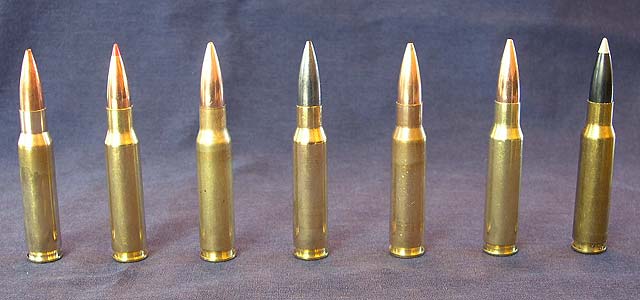 Round 2 loads from left to right: HSM Range, HSM Amax, Umax, Norma DL, Fiocchi, Cor-Bon, Spring River Well, it has been a while since we first conducted the first round of this evaluation and we have been gathering some different ammo manufacturers offerings in 308 168gr match ammo. So, it was time to take these new participants and see how they did. The shooting was conducted on a cool morning over about 4 hours. We expected good things from the Norma ammo and we did get good results. The Norma Diamond Line has a very good reputation, especially their brass, and the ammo did shoot very well from both rifles. I expected a sub .25 group from the bravo but it didn't happen, which is probably shooter error, as the groups were very consistent and right around that .4" or better range. It did shoot a great .151" group out of the 700P though. The Norma ammo is loaded fairly light at a factory velocity of 2549 fps which is quite slow, but will still do what it needs to. The Diamond Line also is moly coated, so be aware that if you decide to use Norma that you are committing to Moly. The HSM AMAX ammo performed well also and is a very good alternative if the AMAX bullet will work for you. I did think the Cor-Bon, which is loaded in the excellent Lapua brass, should have performed better and the number indicated it should have, but the groups did not turn out that good. Again, this could very well be shooter error and this is one we do plan to retest at a later date. The cheap remanufactured Ultramax ammo probably did better than we expected and the Fiocchi was right in the mix as well. The HSM Range ammo didn't do too bad though it is not up to the same accuracy as their standard match is. On the whole, the new crop of ammo brought the overall averages higher in Standard Deviation (thats bad), Extreme Spread (bad), average group size (bad) and the best group size for the 700P (bad). The average best group size in the Bravo-51 actually went down a little. So, it seems that this crop of match ammo was not as good as the initial batch, though some of them performed quite well. In other words, that little statistic really doesn't mean much. We will continue to gather more ammo to add to this testing and we are also preparing tests for 308 175gr, 155gr as well as test for .300 Win Mag and .338 Lapua Ammo. So lots more ammo testing coming! If you would like to request a particular match grade ammo be tested and posted, or if you are a manufacturer and would like to request your ammo be tested, please feel free to email me. 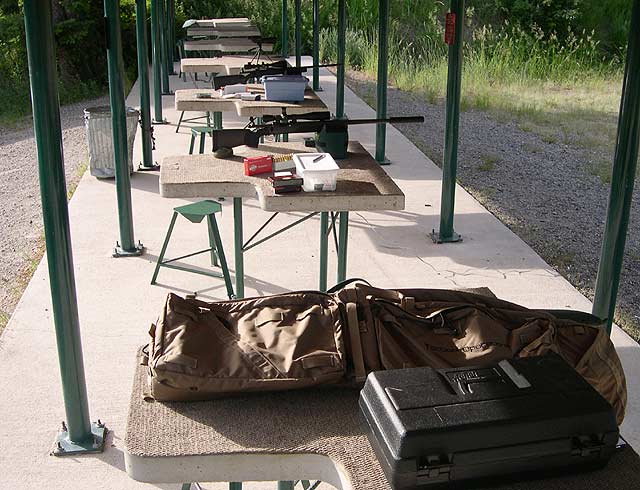
All spread out, hard at work. |
|||||||||||||||||||||||||||||||||||||||||||||||||||||||||||||||||||||||||||||||||||||||||||||||||||||||||||||||||||||||||||||||||||||||||||||||||||||||||||||||||||||||||||||||||||||||||||||||||||||||||||||||||||||||||||||||||||||||||||||||||||||||||||||