
| Manufacturer: | Millett |
| Model Number: | Buck Gold TRS-1 4-16x50mm (BK81001) |
| Finish: | Matte |
| Magnification: | 4-16.0 |
| Objective: | 50mm |
| Tube Diameter: | 30mm |
| Weight: | 29.4oz/834g |
| Length: | 16.4"/417mm |
| Eye Relief: | Avg. 3.5"/89mm |
| Exit Pupil: | 12.5 - 3.1mm |
| Click Value: | 1/8 MOA |
| FOV @100y: | 29' @ 4x 8' @ 16x |
| Adjustment Range: | 65 MOA |
| Reticule: | Custom Mildot |
| List Price: | $499 |
| Street Price: | About $300 |
| Buy Here | |
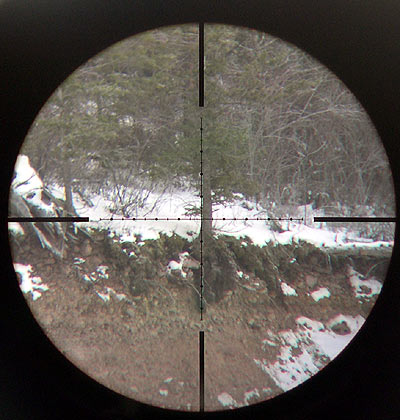
The scope tube is a single piece aluminum tube of 30mm diameter. It has a nice even matte anodized finish, though I noticed the sunshade matte color was slightly different than the main scope body. No big deal. The size of the scope is more of the larger design that has become popular in recent years for tactical scopes, and it does feel robust and durable. The power ring is larger than the eyepiece and has a nice knurled area in which to grab and adjust. The power ring adjustment is smooth all the way around, but there is an actual audible and tactile 'click' right at the 10x mark. It sounds and feels intentional, but I don't know why since the mildot reticule on this scope is accurate at 16x. It would be a very nice feature if that was where the mil-dots were accurate at, but I really cannot explain why it is there on this scope.

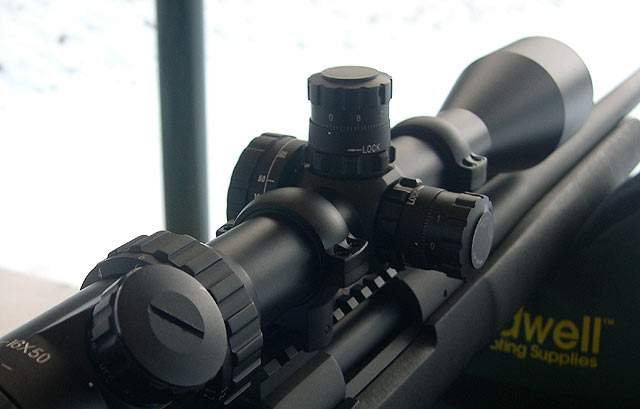
The turrets are of a good size and shape, similar to Leupold M1 knobs and are 1/8 MOA per click. The 1/8 is certainly accurate and allows for very precise adjustments, but on a tactical scope where many scope changes are used, I prefer 1/4 MOA clicks to help prevent having to dial twice as many clicks for adjustments. But that being said, the 1/8th clicks are precise and these knobs are nice. There is 9 MOA per revolution and while the spec sheet says there are 65 MOA of adjustment, this one actually had 109 MOA of vertical adjustments. I have heard 100 MOA from millett directly, and that is what I would plan on having if you were purchasing one of these scopes. The windage knob is marked starting at 1 going each direction, which is a feature I really like on tactical scopes. But, on this particular scope with the 1/8 MOA clicks and only 9 MOA per revolution, at 4.5 MOA you now are overlapping on the numbers. So if you were at 6 MOA right, the knob would read 3. It is not a horrible deal, but some confusion can happen, and it is the same argument for all scopes with knobs marked like this, but on this scope, it happens at only 5 MOA. The other thing I did not like about the knobs is that there is no visual reference for how many times the elevation knob has rotated around zero. Most other makers with external knobs provide horizontal lines on the elevation knob that can be used as a reference for how many times the knob has rotated past zero.
The other interesting feature with the knobs on this scope is the lock rings on both the elevation and windage knobs. The lock ring is knurled also and is located at the bottom of each knob. A slight turn clockwise locks each knob so they will not move. They work as designed and are easy to operate, and there are times where an inadvertent knob turning does happen in the field. I'm not sure how important the feature really is, but it does work and is something other makers do not offer.
Side focus knobs are a popular trend of tactical scopes, as they should be, allowing for precise adjusting of the objective within easy reach while behind the scope. The TRS-1 has a large diameter knob that is marked from 10yds to infinity. The focus works as it should, but there was a problem with how stiff the knob is to adjust. I do not know if it was just this particular scope, or if all of them are like this, but the focus knob is very stiff and hard to adjust. Once applying enough force to twist it, it is smooth, but still requires significant force to keep moving it. I thought it may loosen up, but it has not yet. It is not a two finger twist, but requires ham fisting it. It works and focuses as it should, it is just very stiff to twist.
The reticule is a unique mildot design that is intuitive. There are half mil tick marks to aid in accurate mil readings, and there are dots at the whole mil marks. The dots are very small compared to normal mildot reticules. The USMC mildot is .25 mils, and the US Army mil-dot is .22 (or .2 if you round like the US Army teaches) but these dots are even smaller. The mil sheet provided says they are 1/4 MOA dots, which translates to about .07 mils, or 1/3 the size of a US Army mildot. They don't look quite that small, but I may be mistaken, or perhaps the documentation is incorrect, but they are small. Small dots are fine, just different, and they do not obscure much of the target. The reticule is nicely etched onto the glass for durability. The reticule is on the second focal plane which means it stays the same size no matter what magnification you are on, so for the mildots to be accurate, you have to be on the designated magnification, which for this scope is 16x. The reticule is lighted green with 10 different power settings. I did notice if it was fairly dark like at late dusk and the reticule setting was on the higher settings (above about 8) there was some excess light entering the tube from the lighting component from both the 7 o'clock and 2 o'clock position in the scope. You only really see it if there is not much light out, but it does indicate perhaps the quality of the eye piece housing containing the lighted reticule could use some improvement.
One of the most difficult parts of evaluating scopes is trying to measure optical quality. There is no easy test that I have found that a person can use to measure or compare optical quality. This is especially true with modern scopes where optical quality on even the low end scopes is superior to what was considered good optics about 30 years ago. That being said, the optical quality on this scope, at least with me looking through it, appears to be pretty good. It was clearly better than a low end Barska, but not quite as nice as a Leupold VX2. I would state that the optics are probably about as good as a SWFA SS, or in the Burris Fullfield 2 range, a good middle grade optic.
With the scope mounted on our .308 tactical test mule rifle, the scope performed well shooting through the box accurately and ending where we started. The stiff focus knob continued to be a bit of a hassle while shooting at different ranges, but the target knobs were easy to use, though we did not find ourselves using the locks too often (if at all?). Though we didn't spend much time doing simulated operations, so perhaps those locks would be handier in those cases. Having to dial in all of those 1/8 MOA clicks was also a bit tedious when going between all the different ranges, and you had to be careful to keep track of where you were on the knobs. But in terms of field performance, the scope did just fine and is certainly a usable scope for tactical operations.
The scope is another decent option in the lower-middle grade scopes, but I would like to see a bit better quality control in terms of the very stiff focus knob and the leaking light from the lit reticule. The locking knobs are an interesting distinguishing feature that might be important to some, and there are plenty of elevation adjustments for long range use. For a lower end rifle or someone just getting into long range shooting, this scope is at least worth considering.