
| Manufacturer: | Leupold |
| Model Number: | Mark 4 3.5-10x40mm LR/T M2 (61635) |
| Finish: | Earth Brown Matte |
| Magnification: | 3.5-10.0 |
| Actual Magnif.: | 3.2-9.5 |
| Objective: | 40mm |
| Tube Diameter: | 30mm |
| Weight: | 21.0oz/595g |
| Length: | 13.5"/343mm |
| Eye Relief: | 4.7"/119mm - 3.4"/86mm |
| Exit Pupil: | 11.4 - 4.0mm |
| Click Value: | .5 MOA |
| FOV @100y: | 29.9' @ 3.5x 11.0' @ 10x |
| Adjustment Range: | 65 MOA |
| Reticule: | Illuminated TMR |
| List Price: | $1369.99 |
| Street Price: | About $1369 |
| Buy Here | |
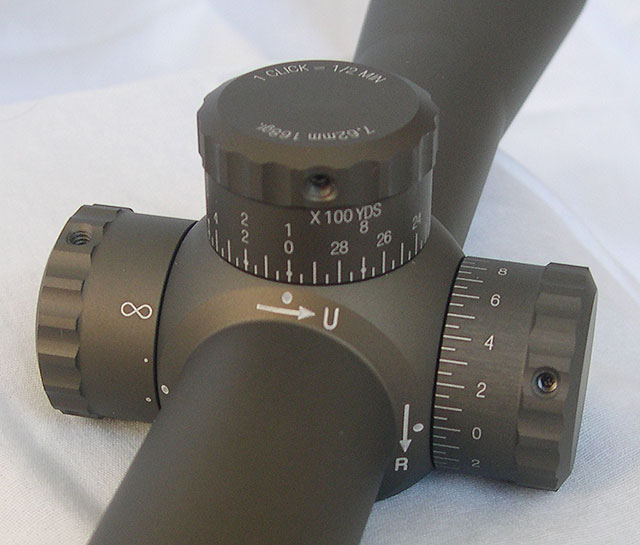
The main feature on this scope that I was very interested in was the M2 knobs and how I liked them vs. the M3 knobs that I very much am a fan of. Both the M3 and M2 knobs are a Bullet Drop Compensating (BDC) knob, set to a specific caliber and load. As you may notice in the above picture, these M2 knobs are closer to the 3.5-10x M3 knobs than the knobs found on the 10x40 M3 scopes (used by the US Army), which are a low profile knob. In fact, these M2 knobs are the same shape and size as the 3.5-10x M3 knobs, so what is the big difference? Well, the ONLY difference is that the M2 knobs are .5 MOA per elevation click while the M3 knobs are a 1 MOA per click. The windage on both the M3 and M2 knobs are the same at .5 MOA per click. The advantage the M2 has over the M3 is that it allows for more precise adjustment and zero (twice as precise... to be exact) The down side is that it now takes twice as many clicks to get to various ranges, which you can get used to, and that you can no longer get to 1000y in a single rotation with the 308. The M2 knobs have 29 MOA of adjustment per revolution and for the .308 168gr Match load that it comes default with, it will get you to 800y in the first revolution, and is marked on the 2nd level for 9 and 10 (1000yards). I think this is an acceptable compromise because the 308 is more practically used from 800 on in, but it is nice to have it indicated out to 1000 in case you need it. Because of that 2nd level on the BDC, care still must be taken if shooting out at 900+ to be sure you keep track of where the BDC is set (300 or 900??). The leupold custom shop will also mark a new knob for whatever caliber you want, so you are not stuck with the .308. Kenton Industries will also make custom marked BDC knobs for this scope, though I do not believe they can do them in earth brown.
The factory says there is 65 MOA of adjustment, though this particular sample had 76 MOA of vertical adjustment, 27 MOA down from factory zero and 49 MOA of up. There should be enough "slop" either direction to zero the scope at 100yards with most typical 308 rifles and still have all the adjustments needed to get to 1000y without a slanted base. You will notice there is a bias in the factory zero to allow for more up MOA. Unless your bases or action are out of whack, you should be okay in most cases. The clicks are precise and offer good tactile feel so you know when the click has happened, and the noise is muted, just the way I like it. I really like these new M2 knobs, I think it is a very good compromise between field adjustments and precision, and I would say I like the M2 knobs as much as the M3's, though I can't really say I like them more, both are excellent.
The brown finish on the scope is anodized and very tough. The custom shop has been offering custom anodizing for a few years now, but it is not normally found on a scope in their standard lineup. This particular brown is almost more of a true OD Green/Brown color. It would mix well in either desert or woodland environments. It is a bit hard to explain the exact color. The finish appears to be the same very durable finish as the other black Mark 4 models and should hold up very well.

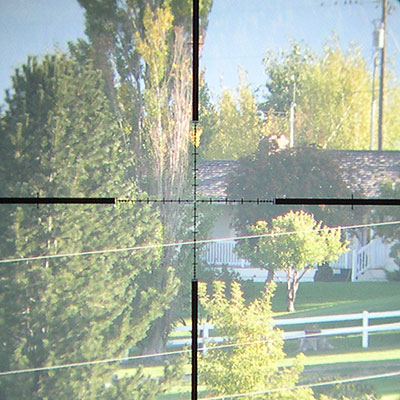
The reticule on this scope is the Leupold Tactical Milling Reticule, or TMR. The TMR, as you can see in the picture or the reticule higher on this page, has larger hash marks at each 1 Mil interval, and smaller hash marks on the .5 Mil intervals. The idea is to help the sniper get more accurate mil readings. I would say it probably helps some, though I would argue not much, as once a person learns the exact measurements of the traditional mil-dot reticule, one can become just as precise. I do like the 10 mil larger hash marks extended out on the larger stadia, as those can be very useful to add flexibility of your measurements. The TMR reticule is actually opened at the center aiming point, with the idea to not obscure vital portions of the target. It is still reasonably easy to get accurate shot placement, though perhaps not as easy as a fine crosshair. The other very nice thing about this particular scope is that it is illuminated.
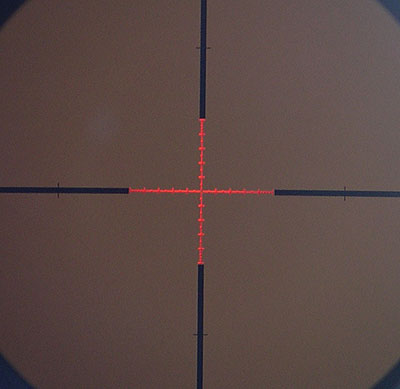
Leupold's illuminated reticules are different than most, as when you are looking against a bright target, you will not see the reticule illuminated, even when turned on. You only see it when you are looking against a darker background, and is why the photo above is taken while looking at a dark "blob". I think this is a very good way of doing it. The only downside is that you may sometimes leave the reticule lit and not realize it, perhaps even storing it with it left on, burning the battery out.
It is apparent that Leupold tried to put together a complete and very capable long range sniping scope, and in my opinion they did a very good job. The knobs are exceptional, and while I do not normally opt for the illuminated reticules on my scopes, they are nice in those few times when you need them. I would probably rather the scope be in black, but either way it is usually wrapped and camouflaged anyway, so its not too much of a concern. The optical and construction quality are excellent and this scope is certainly in the top tier of available scopes for sniping.