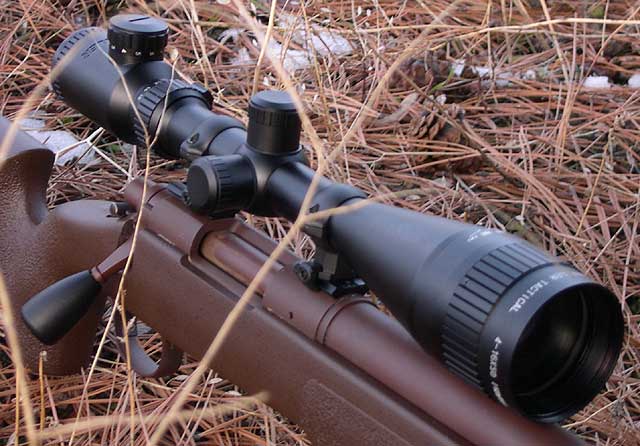
| Manufacturer: | Mueller |
| Model Number: | MT41650IGR |
| Finish: | Matte |
| Magnification: | 4.0-16.0 |
| Objective: | 50mm |
| Weight: | 19.7oz/558g |
| Length: | 14.53"/369mm |
| Eye Relief: | 3.25"/83mm |
| Exit Pupil: | 13.3-4.4mm |
| Click Value: | .125 MOA |
| Adjustment Range: | 60 MOA |
| Reticule: | IL Mil-Dot |
| List Price: | $229 |
| Street Price: | About $229 |
We mounted the scope on a SC1A2 in .308 using a set of Millet weaver style rings that were "High", this gave us about 1mm of clearance off the barrel. For the range evaluation we brought along a Holland Tactical, Leupold Mk4, and Swift 6-18x40mm for optical comparisons. This provided a range of quality in which to compare.
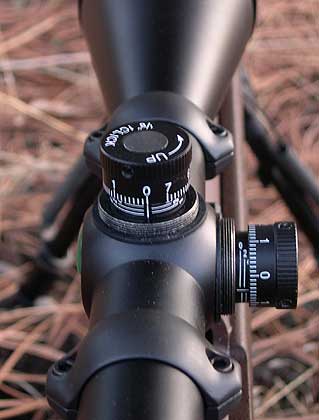
For the shooting, the scope performed well. The scope held zero well (which we expected with just a .308) and the adjustments were accurate. We quickly established a zero and it was right on the rest of the shooting sessions. We ran the scope through the box, starting 6" up and 6" left and then working around the box. Besides being off by .5 MOA on the dials when we rotated through a whole rotation on the knobs, the adjustments were very accurate and shot the box well, and returned to zero with no problems. The scope & rifle combo shot well, shooting several .3 MOA groups, and one sub .25, telling me the scope was a good solid platform.
When comparing the optical clarity and light transmission with the other scopes, it did okay. The leupold was clearly better, which it should be, it costs five times as much. The Holland was also noticeably brighter, well, it should be too, it costs four times as much. The Swift was a good comparison as it was in the same price range as the Mueller. The optics were very similar with good clarity and light gathering ability. If I had to choose one, the Swift offered just slightly better clarity. The adjustable objective on the Mueller is mounted on the bell and worked well at all the ranges we shot at. It does adjust down below 15 yards for those that might be mounting this scope on an air rifle.
The reticle on the Mueller is a nice addition, especially for the price. There are 11 brightness levels on the illuminated mil-dot. Only the inner mil-dot portion of the reticle lights up (red in this case). If you are looking at a bright target you will not even see the illuminated red even at its highest setting, it only shows up while looking at dark targets. On the reticle itself, there is a small space between the ending of the large stadia and the start of the small stadia (that has the dots on it). This is different than most mil-dot reticles, and I think I like it, especially if I can get the exact size of that space in order to use it for precise measurements on small or far away targets. There is no marking on the scope to indicate at what power the mil-dots are correct, but that is fairly easy to remember.
In conclusion, this scope appears to be a good value for the money especially with the nice illuminated reticle, though a few of the "little" things are a bit odd and could stand to be changed and in doing so would really make this a very nice scope. The illuminated reticle may be the "bright spot" of this scope, it works well and is nice when at dusk/dark. We did not test battery life, but the nice thing about illuminated reticles is that the reticle still works even if the illuminated part does not. We will have this scope for a long time to come and will be updating this page periodically to provide long-term durability evaluation. The Mueller Tactical does offer a new set of options over other scopes for the price point, and because of this it is certainly worth considering.